Morphological Search
For some purposes, it may be helpful to retrieve all occurrences of a word in a given grammatical form (for example, to find the word "park" as a noun but not as a verb).
Another frequent task is to find all words that match specific morphological restrictions (for example, to find all singular nouns or all past tense verbs).
In order to perform theses tasks, a morphological tag should be added to the search query. A morphological tag of a word contains information about its part-of-speech and, optionally, additional morphological categories such as number, gender, tense, etc. For a full list of supported morphological categories, see Morphological Categories.
Search of the word in a given grammatical form
In order to search words in a given grammatical form only, one can use functions lemma()/form()/stem()/partofspeech() with a morphological tag as first parameter.
This feature may be especially helpful when dealing with homonyms, i.e. two or more different lexemes which have the same form but are unrelated in meaning (book (noun) — book (verb), can (noun) — can (verb), rear (adjective) — rear (verb), etc.).
Task example: find information about fines
In order to find documents that contain information about fines and penalties, the following query may be used.
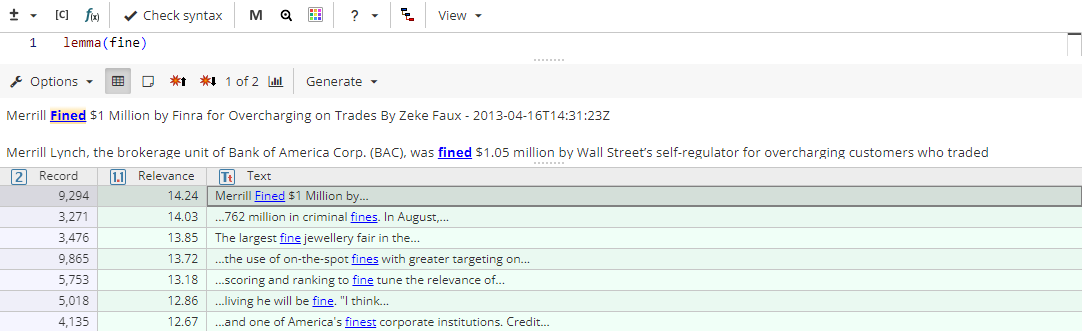
However this query also captures occurrences of "fine" as an adjective, which is unwanted. In order to narrow the search and exclude irrelevant results, a morphological tag should be added.
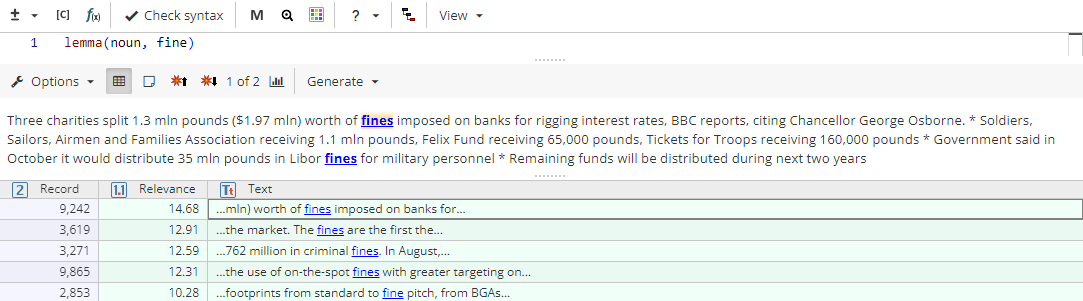
If a morphological tag consists of several morphological categories (for example, part of speech + gender, number + case, etc.), their values must be concatenated by an underscore ("_").
Example
The values order does not matter: verb_present = present_verb.
Users can specify several alternative morphological tags separated by a vertical bar ("|") character. In this case query returns words that match at least one of the listed tags.
Example
Morphological tag is case-insensitive: verb_past = Verb_Past = VERB_PAST.
Search for Words with the Specific Morphological Values
In order to find words with specific morphological values, one can use the functions lemma()/form()/stem()/partofspeech() with a morphological tag as single argument.
Example
If called with a morphological tag as single argument, the functions lemma()/form()/stem()/partofspeech() have identical behavior and thus can be used interchangeably.
Example
Task example: basic analysis of customer feedback
For a surface analysis of customer feedback on product/service it may be helpful to search for all superlative adjectives.
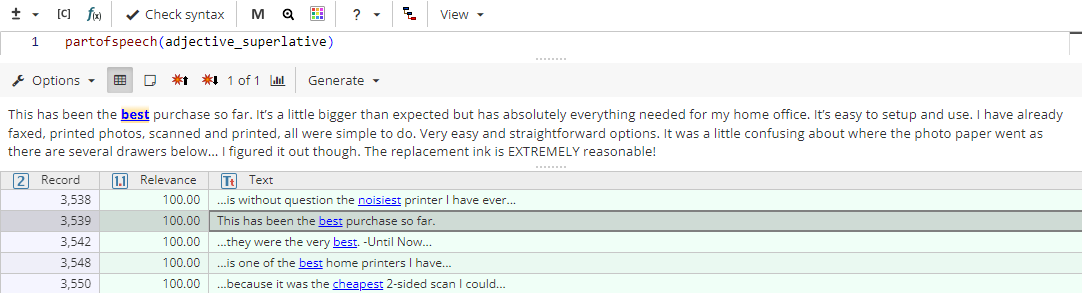
Note
A function with several arguments is equivalent to several functions with a single argument concatenated using the or operator: